
Navigating Together: World Multiple Sclerosis Day 2026
- Stephanie Douglas
- 29 minutes ago
- 5 min read


Every year on May 30, the global community pauses to recognize World Multiple Sclerosis (MS) Day. In 2026, the energy will be higher than ever. Under the theme My MS Diagnosis: Navigating MS Together, we are shifting the focus toward the very beginning of the journey, the moment a person is told they have MS, and how we can make that path clearer, faster, and more supportive.
Multiple Sclerosis is often called an invisible illness, but for the nearly 3 million people living with it worldwide, the effects are very real. Whether you are living with MS, supporting a loved one, or simply want to be a better ally, this guide explores where we stand in 2026 and how we can move forward together.
What exactly is MS? Understanding the Basics
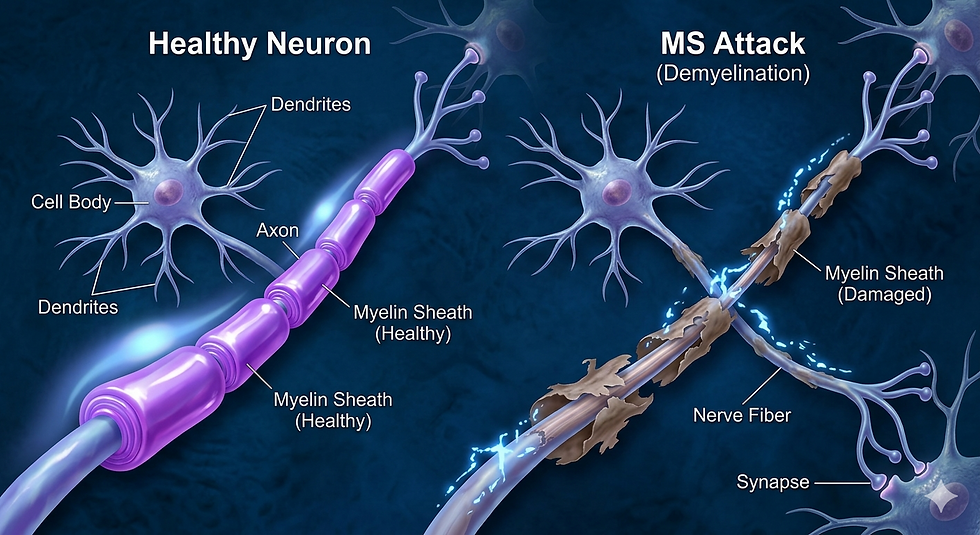
To advocate for change, we first need to understand science. Multiple Sclerosis is a chronic disease of the central nervous system. Think of your body’s nervous system like a complex network of electrical wires.
The Wires: Your nerve fibers.
The Insulation: A protective coating called myelin.
In a healthy body, myelin helps electrical signals travel smoothly from your brain to the rest of your body. In someone with MS, the immune system, which is supposed to fight off viruses, mistakenly attacks this myelin.
When the myelin is damaged, scar tissue (sclerosis) forms. This disrupts the signals. Imagine a frayed charging cable for your phone; sometimes it works, sometimes it’s slow, and sometimes it doesn't work at all. This disruption is why MS symptoms can range from tingling and numbness to fatigue, blurred vision, and mobility issues.
The 2026 Theme: My MS Diagnosis

The global campaign for 2024–2026 focuses on the diagnosis journey. Why? Because for many, getting an answer takes too long.
The Challenge of the Invisible
MS is notoriously difficult to diagnose. Symptoms often come and go (a phase called relapsing-remitting), and they mimic other conditions like Vitamin B12 deficiency or Lyme disease. This leads to the diagnostic odyssey, a period of months or even years where patients feel unwell but have no name for their struggle.
The Goal for 2026
This year, the World MS Day campaign is calling for:
Better Training: Ensuring doctors and nurses recognize early red flags of MS.
Faster Access: Reducing the wait times for MRI scans and specialist appointments.
New Research: Developing better biomarkers (like blood tests) that can spot MS instantly.
Solidarity: Sharing stories so that newly diagnosed individuals don't feel like they are walking into a dark room alone.
Breakthroughs in 2026: Why There Is Hope
We are currently in a Golden Age of MS research. If you were diagnosed twenty years ago, your options were limited. In 2026, the landscape has shifted dramatically.
1. The AI Revolution in Subtyping

Recent breakthroughs at the end of 2025 and into 2026 have seen scientists using Artificial Intelligence (AI) to identify new subtypes of MS. For decades, we categorized MS based on symptoms (like Primary Progressive or Relapsing-Remitting). Now, AI models like SuStaIn are looking at biological data, MRI scans, and blood proteins, to find patterns the human eye can't see.
By identifying Early sNfL and Late sNfL subtypes, doctors can now predict who might have a more aggressive form of the disease. This allows for Personalized Medicine, where treatment is tailored to your specific biology from day one.
2. High-Efficacy Early Treatment
The wait-and-see approach is officially a thing of the past. In 2026, the medical consensus is to use high-efficacy disease-modifying therapies (DMTs) as early as possible. This flipping the pyramid strategy aims to stop brain volume loss before it starts, significantly improving long-term independence.
3. The EBV Link
Recent years have solidified the link between the Epstein-Barr Virus (EBV) and MS. This has opened doors for vaccines and antiviral treatments that might one day prevent MS entirely or stop it in its tracks for those who already have it.
Living Well with MS: Daily Strategies for 2026
Living with MS is about more than just medicine; it’s about lifestyle management. While doctors handle the prescriptions, you handle the daily 24.

Managing the Big F: Fatigue
MS fatigue isn't like being tired after a long day; it’s an overwhelming exhaustion that can hit without warning.
The Spoon Theory: Think of your energy as a handful of spoons. Every task (showering, driving, typing) costs a spoon. Once you're out, you're out. Learning to budget your spoons is a vital skill.
Pacing: Instead of cleaning the whole house at once, do one room and rest.
The Power of Movement
In the past, patients were told to rest. Today, we know that exercise is medicine.
Hydrotherapy: Exercising in a pool is excellent because it keeps the body cool (heat can often make MS symptoms temporarily worse).
Adaptive Yoga: Focuses on balance and flexibility, which are often affected by MS.
Nutrition and Brain Health
While there is noMS Diet, a heart-healthy, anti-inflammatory diet (like the Mediterranean diet) is generally recommended.
Vitamin D: High levels of Vitamin D are often linked to lower MS activity.
Gut Health: Emerging research suggests a healthy gut microbiome can help regulate the immune system.
How to Get Involved This World MS Day
You don't need to be a scientist to make a difference. Advocacy is about small actions that create a big ripple.
1. Wear the Ribbon
The official color for MS awareness is Orange. Whether it’s an orange ribbon, a t-shirt, or lighting up a building, the color represents a beacon of hope.
2. Share the MS Heart
The global MS movement uses a specific hand sign, the MS Heart, to show solidarity. Take a photo and share it on social media with the hashtags #WorldMSDay and #MyMSDiagnosis.
3. Educate Your Inner Circle
Many people still believe MS is a death sentence or that everyone ends up in a wheelchair. Use this day to share the truth: that with modern treatment, many people with MS lead full, active, and long lives.
4. Advocate for Accessibility
Take a look at your workplace or local park. Is it truly accessible? Supporting policies for better ramps, sensory-friendly spaces, and flexible working hours helps everyone, especially those with MS.
A Message for the Newly Diagnosed
If you have recently received your diagnosis in 2026, the world might feel like it has tilted on its axis. It is okay to be scared, angry, or confused. But remember the theme: Navigating MS Together.
You are entering a community of millions who have walked this path. You are entering a medical era where treatments are more effective than ever. MS is a part of your life, but it is not the whole of your life.
Diagnosis is not the end of the story; it is the beginning of a new chapter where you are the lead author, supported by a global cast of millions.

Final Thoughts
World MS Day 2026 is a reminder that while the wires of the nervous system may be damaged, the spirit of the MS community is unbreakable. By focusing on early diagnosis and collective support, we are ensuring that no one has to navigate this journey alone.
Let’s light up the world in orange, share our stories, and keep pushing for a world without MS. Happy World MS Day!
How can you help someone in your community who might be struggling with an invisible illness today?



Comments